Today I will talk about my Ukrainian origins. From my father’s side, which is Romanian, I don’t have much information. Indeed, the access to the archives is not the same in Romania as in my native country, France. When in France, every document can be asked if we are a descendant of the person, in Romania, no documents can be requested if we aren’t the legal representative or the individual himself. So, if you didn’t have any ties with your family, it can be difficult. Thus, I could not trace my genealogy on this side, except for my great-grandfather and I will explain how I proceeded to you right now.
The only document that could help me to trace my grandfather’s family was his birth certificate, despite the poverty of its information. In this certificate, only his mother was mentioned, without giving his father’s name: so, I learned that my last name was a matronymic. Afterward, I decided to learn more about his parents. By tapping his mother’s name on the internet, I found with luck one article in a local magazine that talked about my grandfather’s village during the interwar period, when my great grandmother worked with her husband from a local landowner, around his mill. This moment is evoked by these words “Ivenița Datcu, wife of Ivan (Ion) Romaniuc took care of Liviu Basescu’s vegetable garden”.
What could we conclude with this information? First, my great-grandmother was married to a man and so she wasn’t alone at this moment in her life. Secondly, this husband didn’t have a Romanian origin: indeed, by indicating in brackets “Ioan” and by giving Ivan as the main name, the newspaper shows us a Slavic origin: Ivan isn’t used in Romanian traditional first names. Also, Romaniuc, even if it can be found in Romania, denotes an origin from the north of the country: in fact, the suffix -IUC/-ЮК is typically used to build Ukrainian names: this name in Ukrainian is Романюк. So, we find it mostly in Bukovina, Maramureș, or Moldova.


At this point in my investigation, some complementary sources were necessary to confirm my hypothesis. I had remembered that the Romanian state had made two major censuses during the interwar and after WWII, so I decided to request them. After a month of waiting, Romanian archives replied with a positive answer and another negative. The 1930s census didn’t give a positive result. However, the one of 1948 yes. On this census, I found many interesting facts: first, my great grandmother raised three children: two girls older than my grandfather, and my grandfather himself: his age confirmed that it was the right family (i.e., I didn’t know if my family name was current in this area, so I needed to verify). Secondly, her husband’s name was again misspelled: “Reomaniuc Ioan” but more information was given. Ioan was a carpenter, aged 43 years old. At this stage, a question is still unanswered: Why would a Ukrainian come to Romania, have three children, and not recognize his last child? Something had to be resolved.

Surname, name, age, and profession: Reomaniuc Ioan, 43 years old, carpenter.
The issue had to be solved by questioning the contemporaries: those who know the family history, those who may still be living in its heart, but how could I do that? Sometimes, the answer is not far from us: that’s what I needed to understand. Where? Perhaps you are wondering? Well, who knew this story? Where did I find this information?
To answer these questions, I contacted the editors of the newspaper, without much hope, but as we say: “don’t give up” and it’s what I did: I received a positive reply from the local newspaper, the editor was in fact, a childhood friend of my grandfather: What a revelation: never I had heard about my grandfather’s entourage and at this moment, I knew more about them. This man told me that some members of my family still lived in my grandfather’s village, including his sister! I decided to write a letter to his sister explaining my case and who I am, after two months I got an answer from her daughter who was happy to talk with me. During our message exchanges, I learned more about my family and even received my great-grandmother’s photography, which was a priceless treasure for me.
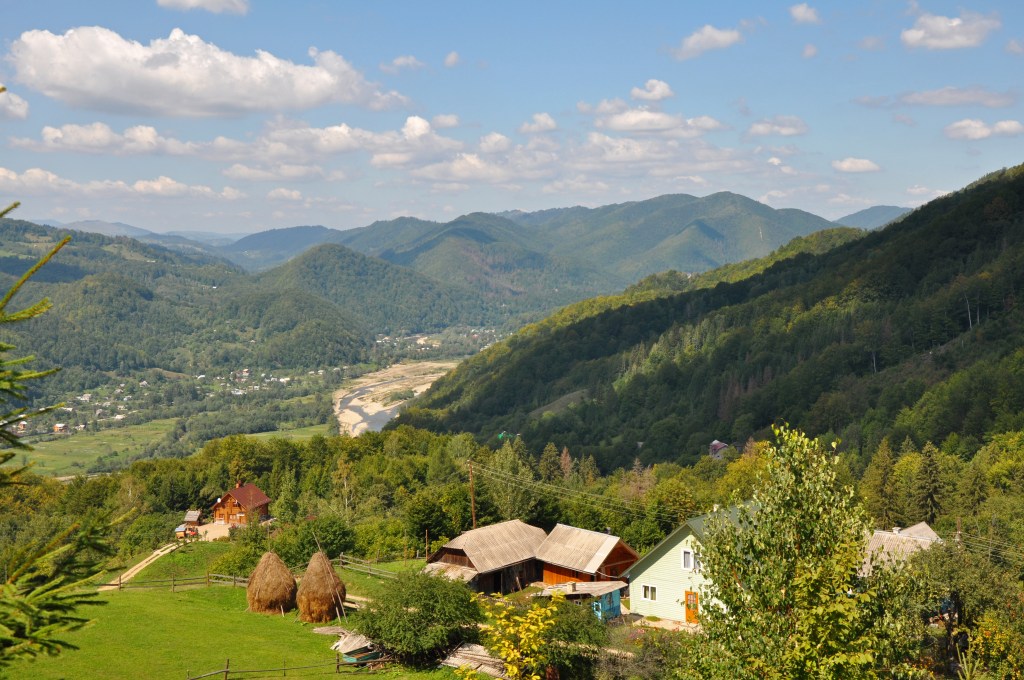
The enigma also became clearer at this moment: the whole truth was revealed by my cousin and made it clearer: my great-grandmother was married to a man during the interwar but unfortunately, he died during a work accident. From this union, one child was born. At this point in her history, she was sent by her in-laws in the north of the country to be a housekeeper for a teacher in Bacău. When the war began, people went hungry, and food was kept for soldiers. Thus, in this situation, people managed as they could. In this way, Ivenița’s boss decided to simply sell her to a soviet soldier for some bread. I don’t know if some parts of its story are fake or real, but what I’m sure to know it’s that this is how they met. My cousin continued to tell me more about our common family history: our great-grandparents had come back to Russia (I.e., URSS, before WWII, Vyzhnytsia was part of the Romanian Kingdom) before leaving that country in 1945. In this period, a child was born: my grandfather’s sister. My grandfather came into our world after those tragic events, in Romania. Ioan’s town was Vyzhnytsia (I.e., in Romanian Vijnița), according to my cousin, a small town located on the Ceremuș river that was part of Romania during the interwar period.

At this moment in my research, my reflex was to check on the internet if some records were online to help me search for my Ukrainian family. Fortunately, the Mormons’ site, FamilySearch had digitized Vijnița records, so I was able to investigate on their site. With the information collected during my investigation, I could target a specific date of birth, a specific name, and a certain place. Thus, by consulting Vyzhnytsia’s records and the surrounding villages, I could find one person who matched my ancestor. However, I had a little problem: Romaniuc was the name of his mother and not of his father. But it was important? I mean, my grandfather didn’t have his father’s name. Why not his father?
Here is the link to the FamilySearch site if you want to learn more about your family history! https://www.familysearch.org/en/
I know, this theory is a bit strange, and we are not used in genealogy to work with approximation but rather with solid facts, proof with documents. And although he was the only Ioan with a Romaniuc parent born within 10 kilometers of this town (i.e., I checked each orthodox parish register in Vyzhnytsia’s Raion), how could I be sure that he was the right boy? Maybe his family came from another region or town, he could be born during a trip. Anything was possible… So, by adding this individual, I took a risk. I’m not sure at 100% that this man is from my family but if we summarize what I said until now, here is my evidence:
- My great-grandfather’s surname is Romaniuc: a Ukrainian name that can be found in the North of Romania, Moldova, and Bucovina. Or Vijnița is a town in Ukraine and more precisely in Northern Bucovina: Bucovina’s part which has become Soviet during the WWII.
- According to the 1948’s census, Ioan Romaniuc was born in 1903: the only child born in Vijnița with this name was Ioan Medeniuc son of Macovei and Maria Romaniuc: he was born the 28/02/1905.
- A DNA test revealed a common origin with some people that have Bucovinian or Ukrainian origins, with names existing in this region.
- Concerning the fact that my grandfather didn’t have his father’s name: I think we can explain that maybe by the difficulty for a soviet soldier to live in Romania after WWII: maybe it was more acceptable and less prejudicial if the child didn’t have a Ukrainian name. With this point of view, we can also explain why Ioan didn’t have his father’s name: A way not to be discovered by the Russian authorities?
- According to Ukrainian archives, one Ivan Romaniuc lived in Vyzhnytsia during WWII, but he was the son of Alex and not the son of Macovei: Where did the first one go?
- According to the same archives, no documents concerning marriage between my great-grandparents, or the birth of their daughter have been found.
- I don’t think my cousin could have invented or found a random town in Ukraine when she told me our family history. I mean if she mentioned this town, that is because we are connected to it: How can we know a Ukrainian town with 4.000 inhabitants without having a personal connexion with it?
At this stage of my research, the mystery is still. What exactly happened with these family members during the last war? Maybe I will never know, or maybe I will discover one day the truth but right now, I can only wait and say that perseverance and patience are very important if you want to be a good genealogist, and I need to keep them if I hope to discover the truth one day. Also, all tracks must be explored even those that are not classical. A great genealogist differs from others by his adaptation capacities and by using various sources.
 Ons-aieux